HiveMind
Agent
engineering
with a shared understanding of how teams build with AI.
Chris Van Pelt
co-founder · weights & biases · coreweave
expo hall · Fully Connected 26
Are these massive Anthropic and OpenAI bills worth it?
The budget owners are getting nervous.
You can't improve what you don't measure.
Agent work is dark matter
claude code
~/.claude/projects
codex
~/.codex/sessions
cursor
…/Cursor/state.vscdb
gemini cli
~/.gemini/tmp
opencode
~/.local/share/opencode
// five tools · five formats · one per laptop · gone when the laptop is
HiveMind
ON EVERY LAPTOP
a small daemon
Finds sessions from every agent. Redacts secrets before anything leaves.
→
ONE BACKEND
one schema
Normalized into one event stream, so Claude Code and Codex read the same.
→
ONE VIEW
the whole team
Visibility follows GitHub: can read the repo, can read the sessions.
hivemind.wandb.tools
The full trajectory
01
Transcripts
Every prompt and every reply.
02
Tool calls
Edits, shells, searches, failures.
03
Costs
Tokens and dollars by user, repo, model.
04
Outcomes
Did it become a merged PR?
// the fourth one is the one everybody forgets
711K
sessions captured
254
engineers
21M
tool calls
24K
sessions → merged PRs
// W&B engineers · through Sep 2026 · regenerate with analysis/hivemind_team_analysis.py
Harnesses
- Cursor: 60% → 19% of sessions.
- Claude Code 22% → 39%, Codex 18% → 38%.
- 2 in 3 engineers used two or more harnesses in a month.
// share of interactive sessions per week · Jan → Sep 2026
Providers
- OpenAI: 18% → 44% of sessions.
- Anthropic: 67% → 46%.
- Switching is cheap when the record is shared.
// share of all sessions (incl. subagents) by primary model's vendor
Delegation
- 22% → 84% of engineers ran a subagent (Jan → Aug).
- Multi-agent workflows: 4 → 102 people in three months.
- Typical engineer: 0.41 → 0.54 subagents per session in two months.
// share of monthly active engineers with ≥ 1 subagent session
Outcomes
31%
of interactive sessions end in a PR
3 in 4
of those PRs merge
55%
of spend comes from the top 10% of engineers
3×
spread in long-session habits, person to person
// PR links are a lower bound: sessions on main or on repos without the GitHub App never get one
Zoom in · my own export
640
merged PRs, out of 714 opened
$53
per merged PR, at list price
1.07M
lines added by agents
97%
of input tokens served from the prompt cache
// hivemind export · Jan → Sep 2026 · 6,768 sessions · regenerate with analysis/hivemind_me_analysis.py
Delegation
- September: 345 sessions from me, 1,648 from my agents.
- 4.8 subagents per session, up from 0.8 in May.
- 7 in 10 sessions, but only about 1 in 5 dollars.
// sessions per month · September is partial (through the 24th)
Parallel work
- 1.2 → 1.7 agents working at once (Jan → Aug).
- 27% of my working time has two or more going.
- A session is open 69 min; the agent works 15.
// 5-minute windows with ≥ 1 tool call · subagents count toward the session that started them
Tool calls
- 60% of 347K tool calls are shell commands.
- The shell fails most: 3.7% vs 2.6% overall.
- A good CLI pays twice: people and agents both use it.
// shell = Bash + Codex exec · Codex doesn't flag failed commands, so real failures are higher
WHAT IT UNLOCKS
Three
payoffs.
payoffs.
troubleshoot
·
share
·
improve
Payoff 01
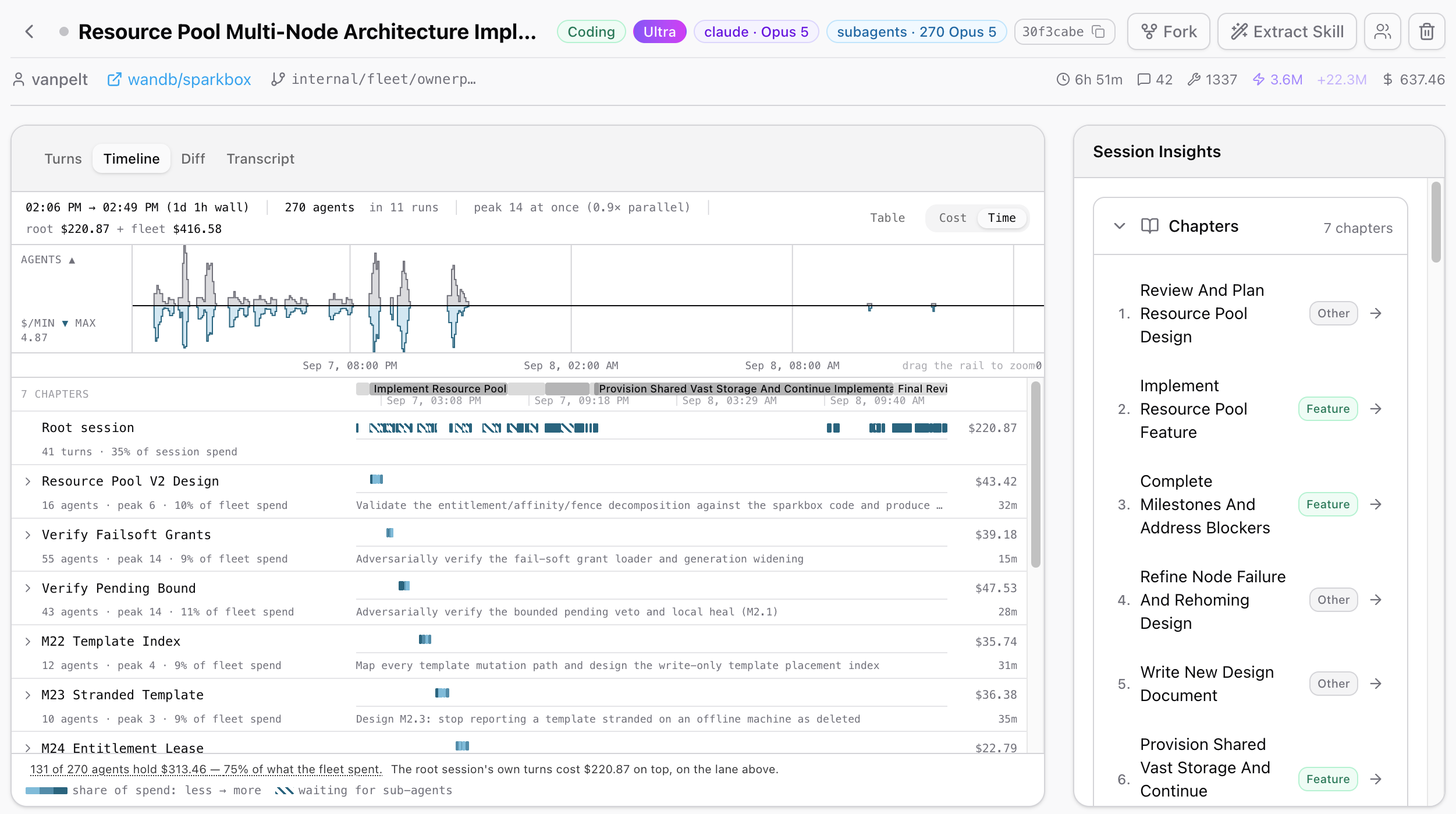
- See how your subagents work.
- Search every session on the team.
- Fork a stuck session to another agent.
// story: the outage fork
Payoff 02
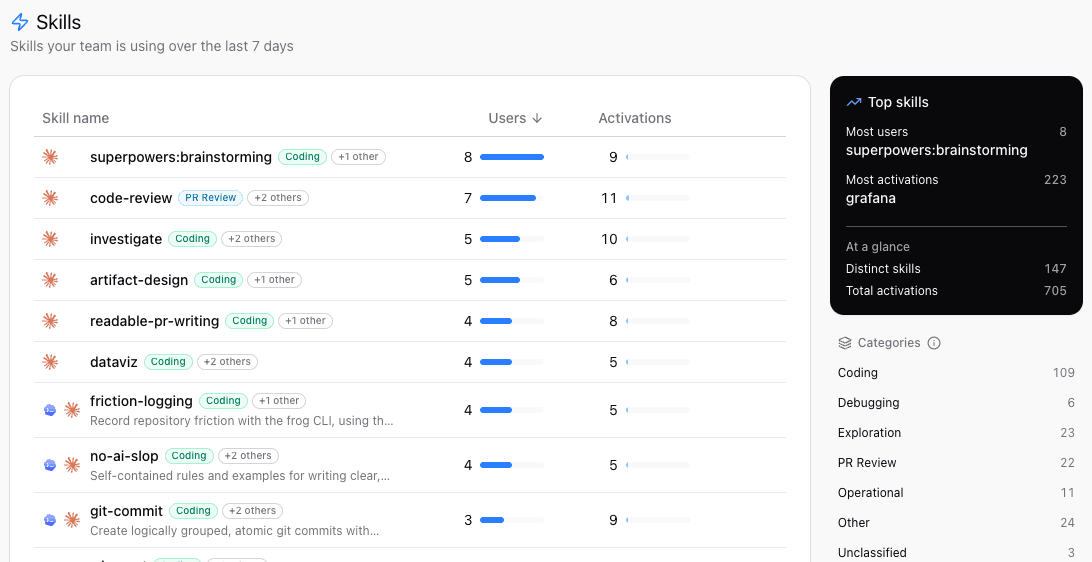
- See which skills the team actually uses.
- "How would a teammate do this?" is one click.
- Your best workflow stops dying in your terminal.
// story: soul stealer
Payoff 03
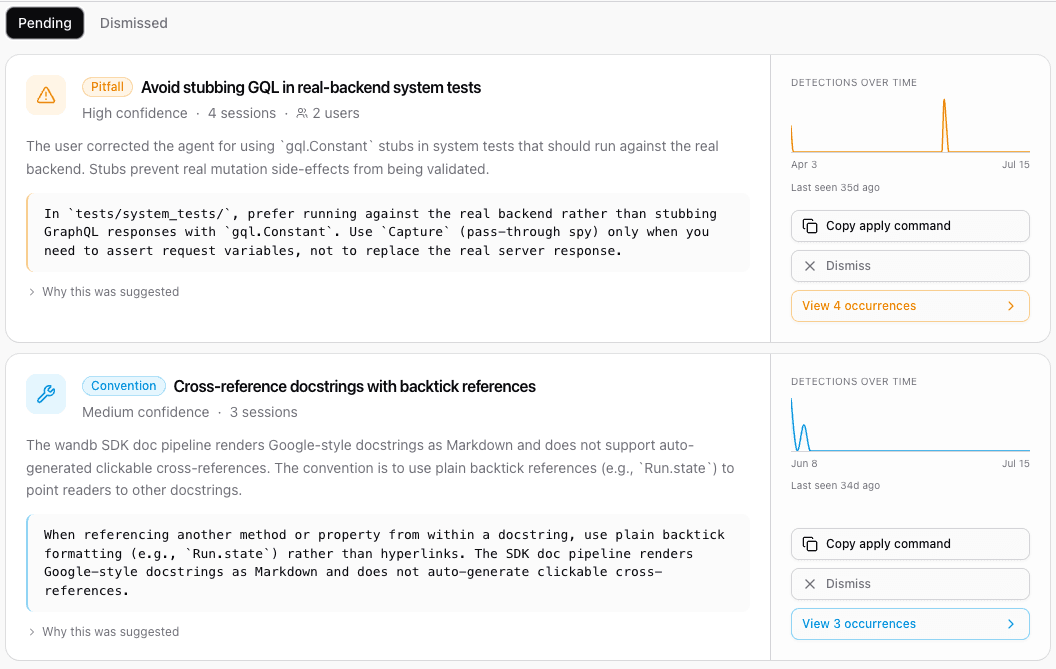
- Find what keeps going wrong, across people.
- Turn it into a rule the agent follows.
- Watch whether it stops happening.
// trajectory → insight → fix → fewer repeats
We asked 49 W&B engineers, 198 times
"How long would this merged task have taken you without AI?"
2 hours
what they said
29 min
what the agent actually worked
5× faster on the typical task
95% beat the estimate
1,613 h said · 234 h worked
BY TASK SIZE
≤ 1 h → 11 min
1–4 h → 34 min
4–8 h → 87 min
1–3 days → 78 min
3+ days → 3.3 h
// in-product survey on merged PRs · Jul → Sep 2026 · medians · agent time = active time incl. subagents
Back of the envelope
5×
faster per task
(the survey)
(the survey)
×
1.7
agents working at once
(me, slide 14)
(me, slide 14)
≈
8.5×
on paper
THE CATCH
1.4×
End to end, tasks only close 1.4× faster than people's estimates.
The gap is us: reviewing, testing, approving. My agent works 15 of every 69 minutes a session is open.
COMING NEXT IN HIVEMIND
Review that keeps up with your agents.
Your team, your data
HOSTED
Sign up in a minute.
Install the daemon, sign in with GitHub, and your sessions start flowing.
hivemind.wandb.tools
SELF-HOSTED
Run it on your own boxes.
One command brings up the whole stack. Your transcripts never leave your network.
curl -fsSL hivemind.wandb.tools/install | sh
hivemind serve up
hivemind.wandb.tools/docs/self-hosting
HiveMind
Thanks.
TRY IT
hivemind.wandb.tools
FIND US
#gpus